

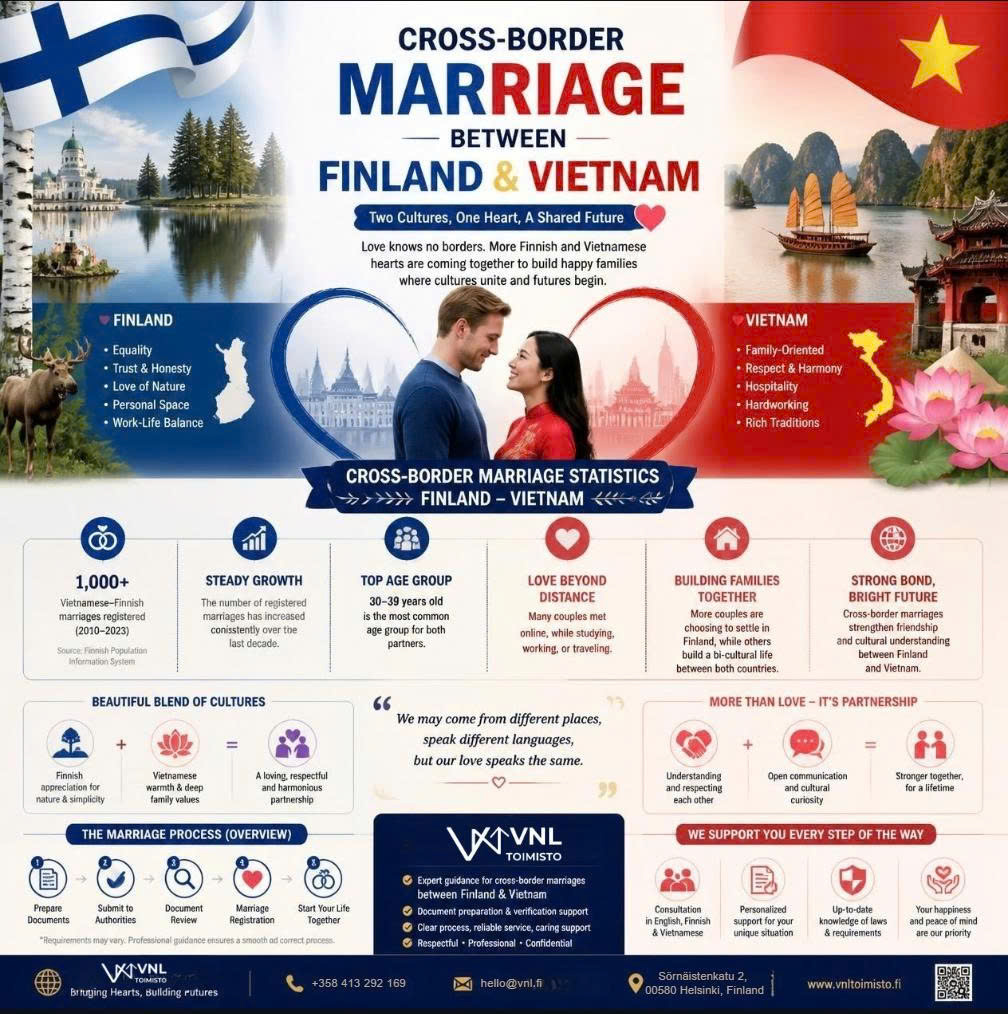
Image for illustrative purposes only
Legally reviewed and advised by Melkko Nguyen (Nguyen Thi Kim Yen) — Founder of VNL Toimisto, Member of the Vietnam Bar Federation, specializing in cross-border legal consulting, document verification, and administrative proceedings between Finland and Vietnam.
Entering into a cross-border marriage between a Finnish citizen or resident and a Vietnamese national involves navigating a complex web of administrative, civil, and immigration regulations in both jurisdictions. Whether the wedding ceremony takes place in Finland, in Vietnam, or at a diplomatic mission, both partners must satisfy rigorous legal conditions to ensure their union is officially recognized and fully protected under law.
Under Finnish law, marriages are governed by the Finnish Marriage Act (Avioliittolaki 234/1929), while procedures involving foreign elements require careful coordination with Vietnamese civil status authorities (Uỷ ban nhân dân or consular posts). Common legal hurdles include obtaining certificates of no impediment to marriage (esteettömyystodistus), consular legalization of civil status documents, and managing subsequent family-tied residence permit applications (oleskelulupa perhesiteen perusteella) through the Finnish Immigration Service (Maahanmuuttovirasto – Migri).
VNL Toimisto provides specialized legal advisory, document verification, and cross-border representation for couples undertaking international marriages between Finland and Vietnam, ensuring seamless administrative processing from initial documentation to permanent settlement.
📞 Planning a Cross-Border Marriage? Contact our Helsinki office at +358 413 292 169 or reach our legal team via Zalo / WhatsApp.
Core Legal Frameworks & Jurisdictional Comparison
Cross-border marriages require reconciling distinct statutory requirements from both nations:
1. Investigation of Impediments to Marriage in Finland (Esteettömyyden Tutkinta)
Before any legal marriage can be solemnized in Finland—or recognized if contracted abroad by a Finnish resident—the Digital and Population Data Services Agency (Digi- ja väestötietovirasto – DVV) must examine whether any legal impediments exist:
The Statutory Application: Both parties must submit a formal request for the investigation of marriage impediments. Foreign citizens must provide valid passports, birth certificates, and official certificates proving their current marital status (single, divorced, or widowed) issued by their home country’s authorities.
Foreign Document Requirements: Documents originating from Vietnam must be authenticated through consular legalization (stamped by the Ministry of Foreign Affairs of Vietnam and the Finnish Embassy in Hanoi) and translated into Finnish, Swedish, or English by an authorized translator.
Validity Period: Once issued, the certificate of no impediment (esteettömyystodistus) is valid for four months, during which time the marriage ceremony must take place.
2. Marriage Registration Procedures: Finland vs. Vietnam
Couples have flexibility regarding where the marriage is officially solemnized, each route carrying distinct procedural pathways:
Option A: Solemnization in Finland: Civil marriages are performed by local register offices (DVV) or district courts, or religious marriages by authorized religious communities. Following the ceremony, the marriage is automatically entered into the Finnish Population Information System (Väestötietojärjestelmä).
Option B: Solemnization in Vietnam: Marriages involving a Finnish citizen and a Vietnamese citizen registered in Vietnam must be processed through the provincial or district People’s Committee (Uỷ ban nhân dân). This requires a certified Certificate of No Impediment issued by Finnish authorities, pre-marital health screenings (including mental health evaluations), and verified identity documents.
Post-Registration Notification: If the marriage takes place in Vietnam, the foreign marriage certificate must be duly legalized, translated, and registered with the DVV in Finland to ensure spousal tax status, inheritance rights, and family reunification eligibility are legally recognized in Europe.
3. Spousal Residence Permits & Family Reunification (Migri)
For a non-EU spouse (such as a Vietnamese national) seeking to join their partner in Finland, securing a residence permit based on family ties (oleskelulupa perhesiteen perusteella) is a critical post-marriage step:
Substantive Requirements: The Finnish sponsor (spouse residing in Finland) must meet strict maintenance requirements (toimeentuloedellytys), proving a stable, legal income that covers housing and living expenses for the household without relying on social welfare assistance.
Integration & Housing: Migri evaluates whether the couple has an established relationship (cohabitation history or a legally valid marriage) and adequate, suitably sized housing in Finland.
Application Filing: Applications are initiated electronically through the EnterFinland portal, followed by an in-person identity verification visit at the Finnish Embassy in Hanoi or VFS Global application centers.
Our 4-Step Legal Advisory Workflow for Cross-Border Marriages
Step 1 — Civil Status Audit & Document Strategy: We review both partners’ civil records, verify eligibility under Finnish and Vietnamese law, and establish an airtight documentation roadmap.
Step 2 — Consular Legalization & Translation: We coordinate sworn translations, consular stamping, and authentication of Vietnamese civil certificates for Finnish institutional acceptance.
Step 3 — DVV Filing & Ceremony Coordination: We assist in lodging the investigation of marriage impediments with the DVV and guide you through civil or religious solemnization requirements.
Step 4 — Post-Marriage Registration & Migri Visa Support: We register foreign marriage certificates in the Finnish population system and prepare comprehensive family reunification applications for Migri.
Frequently Asked Questions (FAQ)
Can a Vietnamese citizen marry a Finnish citizen while on a tourist visa in Finland?
Yes, provided that all statutory documents (such as birth certificates and single-status certificates from Vietnam) have been properly legalized, translated, and submitted to the DVV, and the investigation of impediments is successfully completed within the visa’s legal validity period. However, obtaining a residence permit usually requires applying through proper channels.
What is the maintenance requirement (toimeentuloedellytys) for a spousal visa?
The Finnish Immigration Service (Migri) requires the sponsor living in Finland to earn a net income that meets specific statutory thresholds depending on family size. For a couple without children, the net income requirement is typically around €1,000 to €1,200 per month, though thresholds are periodically adjusted by law.
Do we need a prenuptial agreement (avioehto) before getting married?
While not legally mandatory, entering into a prenuptial agreement is strongly recommended for cross-border couples to protect pre-owned assets, family inheritances, or foreign property holdings from equal division under the default Finnish marital property right (avio-oikeus).
Expert Legal Support for Your Cross-Border Family
Navigate international family law with confidence, legal precision, and complete regulatory compliance. Contact the legal advisory team at VNL Toimisto.
Disclaimer: This publication serves informative legal purposes regarding cross-border marriage, civil status registration, and family immigration under Finnish and international legislation. It does not replace individualized legal representation. Official civil status registrations and residence permit adjudications remain under the sovereign authority of the Digital and Population Data Services Agency (DVV), the Finnish Immigration Service (Migri), and competent consular authorities.